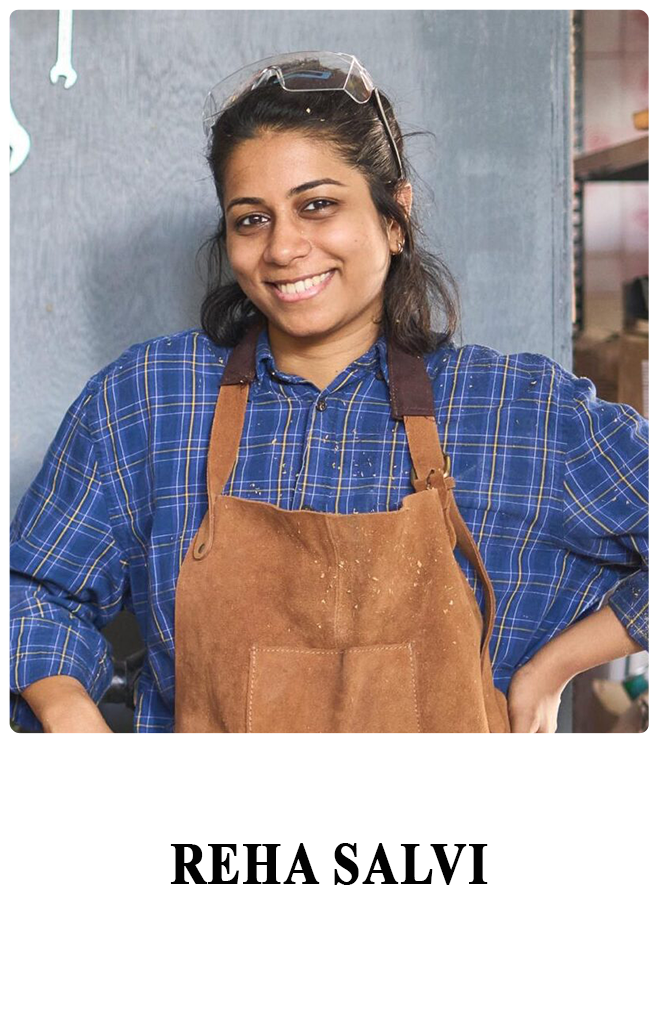
A self-taught woodturner and artist based in Chennai, Reha Salvi is carving out space in a field that remains both niche and under-recognised in India. Working with a lathe, she turns wood into sculptural forms that move beyond the utilitarian objects historically associated with the craft such as table legs, bowls and bedposts reimagines them as carriers of expression. The sculptures draw from her deep connection to nature, as she translates organic forms and natural textures such as tree rings, seed pods, and insect-built patterns into objects that exist in the space between the everyday and the expressive.
As India’s creative economy expands, many niche practices are coming to the fore, traditions that have long existed, but are only now being rediscovered and reimagined in a new artistic light. With over a decade of training and practice in architecture, Reha’s move to woodturning was less a planned shift and more an intuitive pull toward material and process. Having founded her own studio, Lakkadghoom, built around a 300 kg lathe, Reha’s journey as an artist has evolved into a larger exploration than simply making ‘objects.’ More than a space for honing her craft, her studio is a meditative and exploratory environment.
The smell of fresh timber, the steady rhythm of tools, and the soft flight of shavings awaken her senses, turning the act of making into a sensory experience. Reha’s intense connection to her craft, coupled with a drive to explore it through new ways, has earned her recognition, including the Architectural Digest × JSW Prize for Emerging Artisan (2024) and a residency at Hampi Art Labs, milestones that marked the beginning of her journey.
In Hampi, she experimented with local clay, Kinhal paste, and reclaimed objects, further expanding Reha’s creative vocabulary and opening new possibilities beyond woodturning. Working with these new materials, her sculptures began to evolve into more abstract and symbolic compositions. Among them is Consume, a sculptural piece that incorporates wood and a traditional sculpting paste inspired by Kinhal craft to reflect on transformation, time, and nature’s quiet reclamation.
Through woodturning, Reha never set out to make a statement; yet in a country where the craft is rarely seen as contemporary art, and seldom associated with women, her work at the lathe quietly challenges perceptions and often draws surprise. In many ways, Reha’s practice contributes to a larger cultural shift: one where the boundaries between art and craft are being renegotiated, and where niche, material-driven practices are finding new visibility in India’s contemporary art landscape.